
Published on Apr 20, 2016

After Hillary Clinton won four out five states Bernie Sanders released the following statement:
The people in every state in this country should have the right to determine who they want as president and what the agenda of the Democratic Party should be. That’s why we are in this race until the last vote is cast. That is why this campaign is going to the Democratic National Convention in Philadelphia with as many delegates as possible to fight for a progressive party platform that calls for a $15 an hour minimum wage, an end to our disastrous trade policies, a Medicare-for-all health care system, breaking up Wall Street financial institutions, ending fracking in our country, making public colleges and universities tuition free and passing a carbon tax so we can effectively address the planetary crisis of climate change.
Call me crazy, but if I had to boil this down into a nugget of a take away, I’d say something like, “Sanders vows to stay in the race!” or “Sanders will campaign all the way to the Convention,” or “Sanders will push progressive values and platforms.”
But that’s not the dominant narrative among pundits or headlines.
Maybe Sanders is reprioritizing. But that’s kind of not the point. The point is what much of mainstream media chooses to prioritize through its framing and coverage. Why, for instance, if Sanders explicitly states that he will stay in the race until the Convention, are the headlines and hot takes focusing on something that is speculative. The media too often deliver speculation as prophecy, declaring some candidates certain comers and others clearly doomed. Sanders has surpassed their predictions and the public expectations they instilled.
The media should at least pretend they aren’t invested in showing Sanders as a lost cause. And they should pretend to be interested in reporting on what Sanders is actually saying. They can posit that Sanders, by not mentioning a victory strategy, really has chosen to stay in the race to push the Democratic Party to be more progressive. But shouldn’t they start by reporting what they actually know? And then decode its significance? Don’t skip over the newsworthy story, which is that Sanders is going to keep on keeping on.

“Who the heck is this curmudgeon?” wondered David Sillen, 72, of Middletown, New Jersey. A semi-retired creative director, Sillen stumbled across an article about “this guy who’s complaining about everything.” When he looked at the man’s photo, he said, “Oh my god, It’s Bernie. It ain’t nobody but Bernie.” Sillen realized the curmudgeon was his former neighbor, schoolyard buddy, school and Hebrew School class mate. The two of them would walk to the James Madison High School in Midwood, Brooklyn, every day.
David also realized, “It wasn’t about being a curmudgeon. It was about Bernie being so passionate about his feelings. And I sat back and said, you know, the guy’s right. He’s really right about this stuff.”
But back to the early days.
Bernie the Athlete: Sillen and Sanders played sports together and he’s still impressed by Bernie’s athletic abilities. Sanders was the captain of the track and cross country teams and, recalls Sillen, “one of the best distance runners in the city. He was more of a guy who led by example… before a meet he didn’t get us all together and give us rah rah talks. Nobody practiced harder than Bernie. Nobody tried harder than Bernie when we were in meets. And most of the time he came in first.” He was also a very good “school yard athlete,” who played “stick ball and punch ball and slap ball and ringolevio.” Sanders was “a good school yard basketball player. He was a very tough rebounder. He was skinny and had long arms.”
Bernie the Mensch: Sillen said, “When I say he was a regular guy he was a regular guy. He was a mensch.” And, unlike others who have made it and left their menschitude behind, Bernie has stayed mensch: “If you were born Jewish and in Brooklyn it was in your DNA to be a Democrat and liberal. A lot of the guys we grew up with who became ultra-successful and ultra-rich — I’m sure left that behind. But Bernie took it to the nth degree, I guess. A lot of us are still liberal Democrats and we support him wholeheartedly.”
Bernie the schoolgirl crush: Given that Bernie was such a mensch and such a great athlete, it should come as no surprise that he was considered a catch. “As a matter of fact we had our 50th high school reunion and when he started running for president we started getting all kinds of emails and texts from girls admitting that had crushes on him.” And why not? “He was a good looking guy. Not vain in the slightest… He was a good student… He was a little on the shy side.”
You can hear the entire interview with David Sillens at Talk Bernie to Me, the new podcast from Babes for Bernie.
Can you spot Bernie among the Bernie Bros in this photo of David’s Bar Mitzvah? We will let you know tomorrow. But feel free to guess in the comments!

As a hint, this is Bernie’s yearbook photo, which he signed for David.


Originally posted April 19, 2016 on RawStory
You may have seen this “On Becoming Anti-Bernie” piece, which is going around the internets. It’s one of the top three most popular posts on Medium’s politics section, has 1.4k likes, and over 600 comments. But who is the author? Robin Alperstein? She’s a corporate lawyer who specializes in defending hedge funds but also represents the occasional nanny-abusing, jet-setting, Chilean aristocratic Upper East Side couple.
Lest you think I’m bringing up Alperstein’s biography because I can’t rebut the substance of her argument, I’ll go through a mere sampling of its flaws.
Let’s start with one of her bald-faced lies. Alperstein writes that Sanders, “literally pushed his wife away from a lectern (‘don’t stand there!’) on the air.” Actually, Bernie gestured. He never touched her. And there is video. So Alperstein either didn’t watch it (is “lazy and unprepared,” which are literally the words she uses to describe Sanders) or she’s a liar.
Also, as a Clinton supporter, does Alperstein really want to make this election about the relationship between the candidate and his or her spouse. By all means, as a Bernie supporter, I’d be happy to.
But the piece is generally chock full of distortions and myths that persist despite lack of evidence: Sanders hasn’t accomplished anything (which is weird because he has and his nickname is the Amendment King); he never compromises (which is even weirder since Alperstein points to examples of compromise in the same piece); has no foreign policy experience (he has more foreign policy experience than Ronald Reagan or Barack Obama did when they ran for first election, was right on Iraq. And Clinton was wrong on Iraq, but to be fair, her being wrong shouldn’t be limited to that one incident. She’s also been wrong on Libya, Haiti and Honduras, where she legitimized a coup that has rendered the country the “murder capital of the world.”)
The piece also uses glaring double standards. It smears Sanders as “lazy,” while attacking Sanders for his tone. I guess she’s showing instead of telling. So, well played Alperstein. It attacks Sanders on his temperament, which is so important, it has its own “temperament” subsection: “Sanders is crotchety,” Alperstein writes. And, when questioned, he apparently becomes, “testy and sarcastic.” If temperament is fair game, that’s great news for Sanders supporters. Because we can now talk about Hillary’s cold yet fake, awkward yet disingenuous demeanor, yes?
Alperstein condescendingly writes that Sanders “doesn’t seem to have an ‘inside voice’.” Shall we talk about the cadence or volume of Clinton’s voice?
Perhaps my favorite critique is that he gets “red-faced.” I won’t dignify this by responding to it beyond saying talking about a candidate’s physical appearance is not a good look.
OK. Now back to Alperstein. Who is she, you ask? Well, she’s a partner at Becker Glynn. And, according to the website, she specializes in

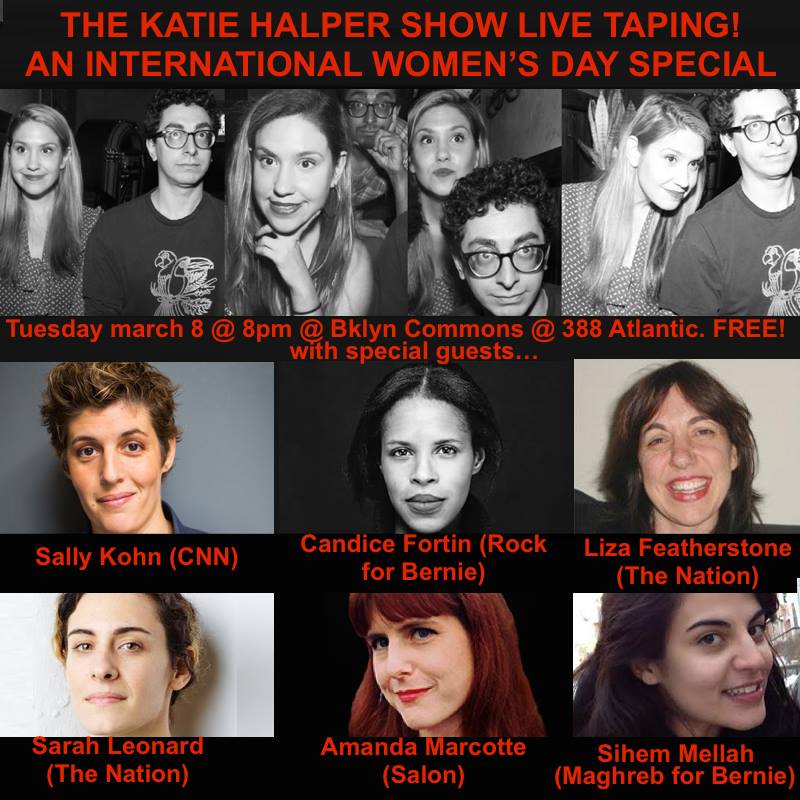
 This month’s show features guests who shatter the myth of the Bernie Bro, the alleged white male millennials, living in their parents’ basements, harassing women online and supporting Bernie Sanders. Leslie Lee, a Black writer and teacher was so frustrated with the misrepresentation of Sanders fans and the erasure of his supporters of color, he created the spot on and very funny #BernieMadeMeWhite hashtag, which went viral. Erika Andiola is a dreamer, organizer and she happens to be a National Press Secretary for Bernie Sanders Campaign for President. Jacob Bridge, a VeteranForBernie and conscientious objector who has organized around LGBT rights, is also far from a Bernie Bro. So, come, learn, laugh, nosh and drink at this live and free talk show! livestream here https://livestream.com/thecommons/events/5125512
Wednesday, April 6 at 6:00 p.m. at Brooklyn Commons (388 Atlantic Ave, Brooklyn, New York 11217)

Leslie Lee III is a writer and English teacher from Baton Rouge, LA who lives in Yokahama, Japan with his wife, Kelly, and their dog, Taco. His writing ranges from essays and articles on politics and Japanese wrestling, to the novel he is working on with his father about Kentucky’s Black coal miners. But according to some sources, Lee does not actually exist. He’s a figment of the imagination. Because he’s both Black and a supporter of Bernie Sanders.
The nice thing about the notion of the unbearable whiteness of being a Sanders supporter is that it doesn’t need to be based in reality. On Saturday, for example, CNN attributed Sanders’ landslide victories in Alaska, Hawaii and Washington primaries to the whitey-mcwhiteyness of the states:
These caucus states — largely white and rural — are the type of places Sanders traditionally does well. In order to win the nomination, he must replicate this success in other, more ethnically diverse states that hold primaries, as he did in Michigan last month. In theory, it’s possible. But the reality is tough.
Likewise, in theory, it’s possible to portray these states as white. But the reality is tough. Because they’re not. Washington state is literally the seventh most diverse state in the Nation. Two (if not three) of the five most diverse counties in the country are found in Alaska, which CNN itself described as “the most diverse place in America,” in an article in January. And Hawaii, according the Pew Research Center,
stands out… more than any other state… when it comes to its racial and ethnic diversity… The Rainbow State has never had a white majority. In fact, non-Hispanic whites, the largest group in most states, account for only 23% of the population, according to 2013 census figures.
But you know the old adage, necessity (to correct irresponsible journalism and media bias) is the mother of (viral) invention. And So, Mr. Lee launched his epic #BernieMadeMeWhite hashtag, mocking the idea that all supporters of Sanders are white. Its debut appearance was:
@HillyesRose @MisaelFrancoO @TheBpDShow @cenkuygur I knew it. I knew if Bernie won Hawaii it would magically become a white state.
— L. (@tokyovampires) March 27, 2016
.@HillyesRose @MisaelFrancoO @TheBpDShow @cenkuygur Ever since I voted for Bernie, I’ve been bingewatching Friends. #BernieMadeMeWhite
— L. (@tokyovampires) March 27, 2016
I decided I would ask Mr. Lee, or @tokyovampires as he’s known on Twitter, about what inspired the hashtag, though merely ignoring it and him would have been a very meta demonstration of the very erasure he’s protesting.
He explained, “The common narrative in this election that Bernie has a ‘minority problem’ or that all his supporters are ‘bros’ is pervasive, and insulting to the POCs [People of Color] and women who support [him].” But, “it hit a peak… when Hawaii, the least white state in the nation, retroactively became white or ‘not diverse’ due to the fact that Bernie won it. So, I started #BernieMadeMeWhite.” And, Lee tweeted to me, “since my real existence as a black person who supports Bernie is ignored… might as well embrace my new whiteness.”
Lee was kind enough to answer some more questions over e-mail, probably out of a sense of solidarity, since I’m a female Bernie bro and don’t really exist either.

Originally posted on March 25, 2016 on RawStory
Countless people, newspapers, pundits, self-appointed definers of all things Jewish have challenged, questioned or even denied Bernie Sanders’ Jewish identity… because it’s a Friday. Speaking of which, good shabbos!
It’s hard to keep up with all the self-righteous attacks and denouncements lobbed at Sanders but one of my favorites from this week alone was the nuanced and understated headline which graced the schlock-filled right wing rag that is Front Page:
HOW BERNIE SANDERS SOLD HIS SOUL TO BE AN AUTHENTIC LEFTIST
This soul selling was, of course, a reference to Sanders’ decision not to the annual AIPAC conference.
But I don’t want to leave out Jeffrey Goldberg, whose condescending and catty tweets about how Jewish identity is appropriately defined, was stunningly unaware. Goldberg tweeted truth to power during the Sanders-Clinton debate in Flint Michigan from earlier this month when host Anderson Cooper said the following:
Just this weekend there was an article I read in the Detroit News saying that you keep your Judaism in the background, and that’s disappointing some Jewish leaders. Is that intentional?
(Because if there is one publication that represents THE JEWS it’s definitely the Detroit News or DN, as we Jews like to call it. And if there is one group of people who speaks for the Jews, it’s definitely “some Jewish leaders.” But that’s neither here nor though, so moving on.) Bernie made the mistake of saying that part of his Jewish identity was shaped by the Holocaust, during which his father’s side of the family was “wiped out.” Well, that didn’t sit too well with Jeffrey Goldberg, who sanctimoniously tweeted:



Like many people, I found out about the death of Antonin Scalia through social media, a Facebook chat to be specific. “DUDE! Scalia may be dead,” my friend messaged me.” After a few minutes of silence, my friend returned, in all caps, once again, to proclaim, “HE’S DEAD!!!!!!!!!!!!!”
While Scalia’s unexpected death provoked a pseudo-constitutional crisis among the right wing, it provoked an existential crisis in me. I felt simultaneously happy, relieved, hopeful and guilty. He’s someone’s father! Someone’s husband! RBG’s bestie and opera partner! Even worse than what I felt was what I wanted to do! “OMG!” I typed to my friend. “Would a listicle of Scalia’s Worst Quotes be the worst?” Ironically enough, my friend’s verdict was Scalian; swift, punishing and punctuated with hyperbole and exclamation points: “NO! YOU MUST DO IT!” F&*( DECORUM!”
A woman of checks and balances, I sought counsel from other sources via other means of communication. I skyped an editor to ask for her ruling on the issue. Her judgment was Kennedyian and moderate: She urged me to wait 24 hours, reminding me that “dancing on people’s grave [was] not a good look.” When I texted another friend, a journalist, he concurred with the editor, writing, “I wouldn’t celebrate it.”
The majority, it seemed, had ruled. It would be in poor taste and bad judgment, an ethical breach, to openly rejoice about Scalia’s death.
I had no grounds for appeal. The decision was final… or so it seemed.
But then, I felt a flickering of hope, as I saw a flickering of light from my cellphone. With bated breath, I watched as dots of i-message judgment popped up on my screen. The journalist, it seemed, hadn’t finished his ruling: He thought I could make the argument that his death may have “saved the planet” with the court now unlikely to strike down Obama’s far-reaching emissions plan. “He was a bigot who made millions of people suffer.” With this Breyersian analysis, my friend granted my piece, which I had planned to kill, a last-minute reprieve.
I decided I’d “nudge,” if not totally violate, decorum. I compiled some of the late justice’s most “memorable quotes.” I can’t say I’m proud of my word choice. The cop-out-est of adjectives, “memorable” allowed me a convenient vagueness. But, in all fairness, Scalia’s equal opportunity bigotry made it hard to come up with a headline-length title that did him any justice: “Scalia’s most homophobic and/or sexist and/or racist and/or savage decisions, quotes or off-the-cuff statements” is a mouthful.
The guilt I felt over turning Scalia’s death into shareable content started to dissipate as I sorted through the bottomless pit of sexism, homophobia and racism that was his legacy. His cruel and draconian incarceration opinions, which had caused so much suffering, now offered me comfort, solace, conviction and a sense of righteousness.
But what really emboldened me was his near fetish for death and the death penalty. Not only did Scalia defend capital punishment for youth and people with mental disabilities, he also has famously said, out loud, that it wasn’t unconstitutional to execute the innocent as long as they had a fair trial: “[t]his court has never held that the Constitution forbids the execution of a convicted defendant who has had a full and fair trial but is later able to convince a habeas court that he is ‘actually’ innocent.”
Why should Scalia, who was so brazen about his disregard for human life, even innocent life, deserve respectful or solemn commemoration in the public sphere?
Scalia wasn’t merely defending the death penalty in theory as an acceptable and appropriate punishment for guilty people; he was defending it for the innocent if it came to that. And, as one of the nine people on the Supreme Court, his ideas contributed and buttressed the state-sanctioned murder of innocent people.
Surely, whatever deficit of empathy I revealed paled in comparison to Scalia’s chasm of compassion. If he could sleep soundly with the deaths of innocents on his mind, who was I to feel guilty about a death I had nothing to do with. It seemed wrong. And also, profoundly un-Scalia-like. And that was when it occurred to me: What better way to honor the late justice than by asking #WWSD? What would Scalia do? The answer was obvious: He’d react to the loss of human life with heartlessness, cruelty and adherence to his own conviction.
![Killer Mike introduces Sen. Bernie Sanders (I-VT) during a campaign rally in Atlanta on Nov. 23, 2015. [YouTube]](https://i0.wp.com/2d0yaz2jiom3c6vy7e7e5svk.wpengine.netdna-cdn.com/wp-content/uploads/2015/11/Killer-Mike-introduces-Sanders-112315-800x430.jpg)
Originally posted on RawStory on February 17, 2016
Rapper and Bernie Sanders endorser Killer Mike made a terrible mistake on Tuesday night when he quoted “a woman” who used the word “uterus,” during a speech at Morehouse College in Atlanta. Twitter and several media outlets blasted Michael Render, AKA Killer Mike, for sexism. Interestingly, most of them didn’t bother to explain what he was really saying or who the woman he had cited was: feminist, anti-racist educator and activist Jane Elliott.
Here is what he said:
https://vid.me/e/OZAv?stats=1&tools=1
When people tell us ‘hold on, wait a while’ – that’s what the other Democrat is telling you, ‘Hold on Black Lives Matter, just wait a while. Hold on young people in this country, just wait a while,’ And then she get good, she have your own momma come to you, your momma sit down and say, ‘Well you’re a woman.’
Render is describing what he sees as an attempt on Clinton’s part to appeal to gender identity to get the vote. Whether or not you think this is accurate is another question. But we can all agree on what he’s saying. He goes on:
I talked to Jane Elliott a few weeks ago, and Jane said, ‘Michael, a uterus doesn’t qualify you to be president of the United States. You have to have policies that’s reflective of social justice.’ ”
To me, it’s pretty clear what Render is saying here. Again, you don’t have to agree with him, but the point he is making is that policies and not gender determine whether someone is actually promoting social justice.
Somehow the takeaway from this was,”Killer Mike Quotes Woman Saying ‘Having a Uterus Doesn’t Qualify You to Be POTUS’” as Blue Nation Review headline put it. The Hill said, “Rapper Killer Mike drew attention late Tuesday after saying during a rally for Democratic presidential hopeful Bernie Sanders that a “uterus doesn’t qualify you to be president.” And Mediaite wrote that he “got pretty fired up about Team Clinton saying “just wait a while” and quoted a woman who told him, “A uterus doesn’t qualify you to be President of the United States.”
 katiehalper.com